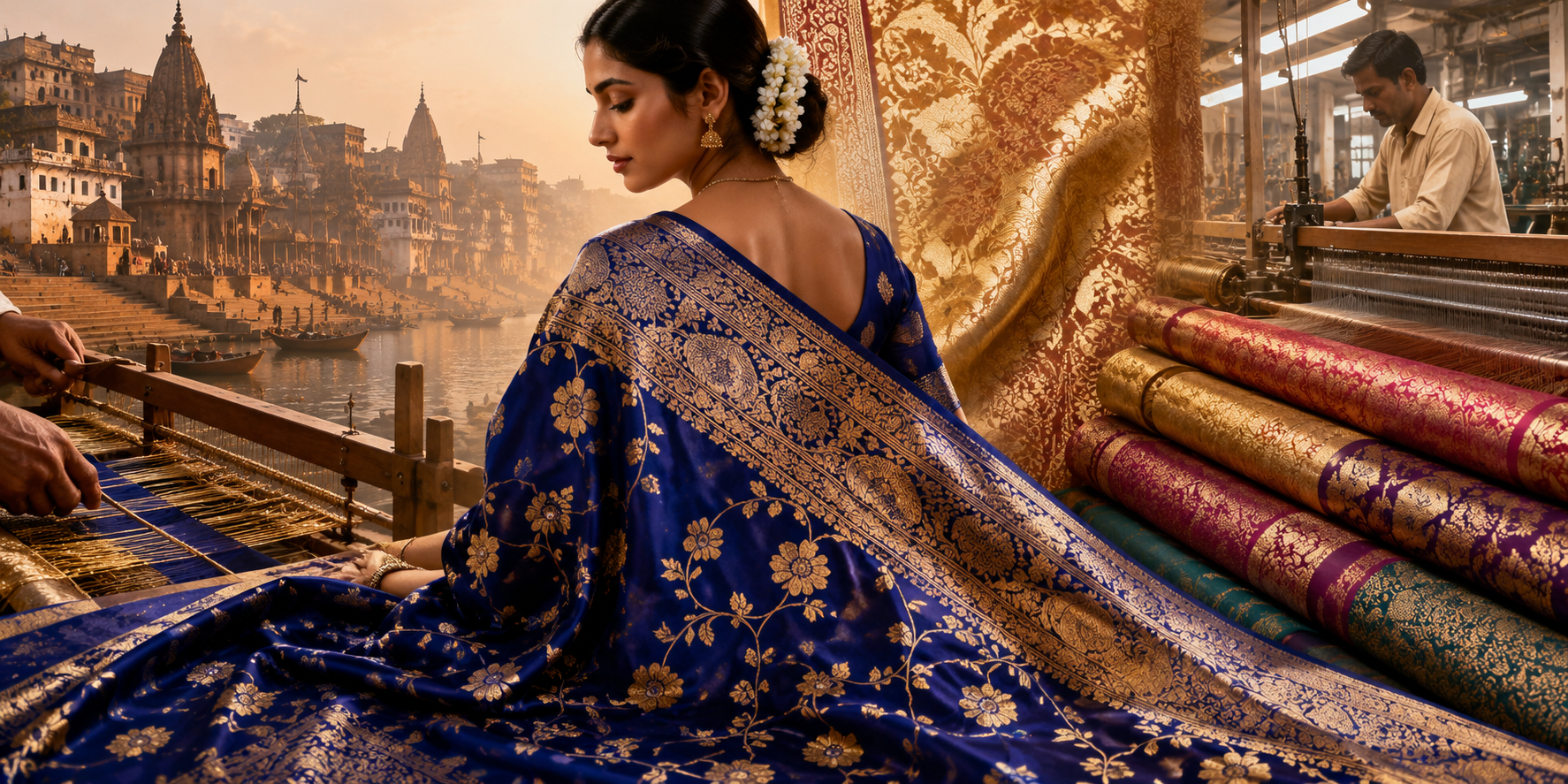
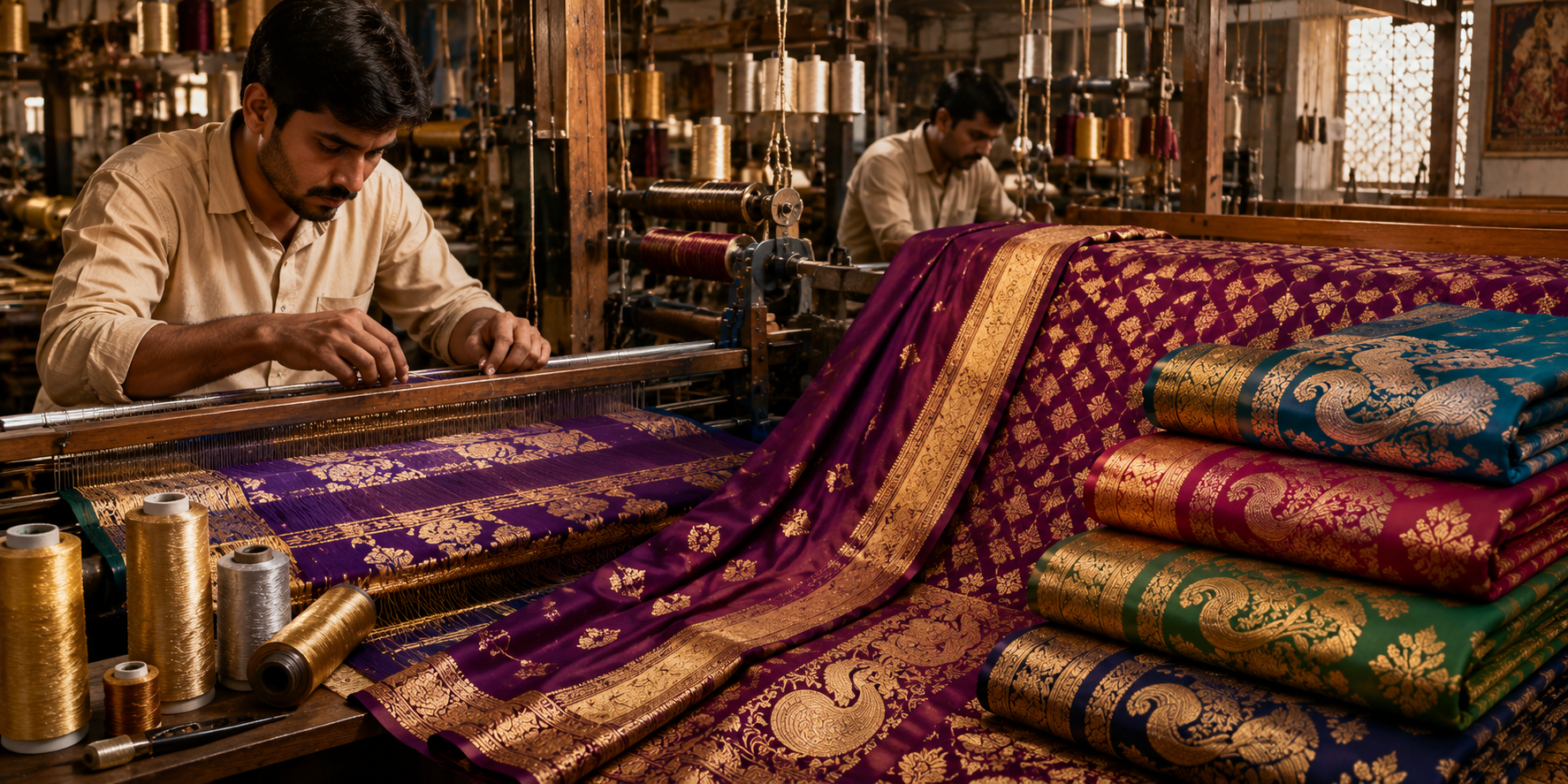
Handloom vs Powerloom Saree
The words "handloom" and "powerloom" describe how a textile is woven.
They should not be treated simply as labels for "good" and "bad".
Both methods can produce attractive textiles, but their production processes, characteristics and pricing can differ.
What Is a Handloom Saree?
A handloom saree is woven using a loom operated by hand rather than a mechanically powered weaving system.
The weaving process can involve considerable human skill and time.
Depending on the textile, handloom construction can produce distinctive characteristics in:
- Motifs-Texture
- Selvedge-Weave structure-Minor variations
What Is a Powerloom Saree?
A powerloom uses mechanical power to operate the weaving process.
It can produce textiles more efficiently and consistently at scale.
Powerloom sarees can still have attractive:
- Colours-Designs
- Finishing-Fabric quality
The production method is simply different.
Why Do Handloom Sarees Cost More?
Price can reflect:
- Weaver labour-Production time-Fibre
- Zari-Design complexity-Weaving technique-Geographic craft tradition
But price alone does not prove that a saree is handloom.
A high price is not an authenticity certificate.
Can You Identify Handloom by Looking at the Back?
The reverse side can provide useful clues about construction, particularly in woven motifs.
But buyers should avoid relying on a single visual test as absolute proof.
Different handloom and powerloom constructions can look different.
For expensive purchases, ask for reliable product documentation and provenance where applicable.
Look at the Motifs
Examine:
- Pattern continuity-Weave structure-Border construction-Pallu
- Reverse side-Selvedge
Close-up photographs can be much more informative than a model photograph.
What About Small Irregularities?
Handcrafted textiles may show minor variations.
However, an irregularity does not automatically prove handloom construction.
Likewise, an extremely clean appearance does not automatically prove machine production.
Always consider the full evidence.
What Should You Ask a Seller?
For an expensive saree, ask:
- Is it handloom?
- Where was it woven?
- What is the fibre composition?
- What weaving technique was used?
- Is there certification where applicable?
- What type of zari is used?
- Is the design woven or printed?
- What is the saree length and width?
A transparent seller should be able to explain the product rather than relying only on phrases such as "premium" or "luxury".
Is Powerloom Always Bad?
No.
Powerloom production can create affordable, consistent textiles.
The important issue is accurate product description.
A powerloom saree should not be falsely represented as a handloom saree.
Is Handloom Always Better?
"Better" depends on what you want.
If your priority is:
- Craft heritage-Weaver-made construction-Traditional textile techniques
you may prefer handloom.
If your priority is:
- Budget-Consistency
- Availability-Easy repeat purchasing
a powerloom textile may also suit you.
Final Takeaway
Handloom versus powerloom is fundamentally a question about production method.
When buying, focus on transparency, construction, fibre, provenance and the actual qualities you value.
Do not judge a saree solely by price or by one visual "test".
Explore Shahidhara's textile-focused Sarees and read the individual product descriptions carefully before purchasing.